Schema Design
How elements are named, scoped, and modeled. Naming conventions, domain namespacing, and the concept/property/vocabulary decision tree.
1. Naming conventions
Casing encodes element type:
| Element type | Convention | Examples |
|---|---|---|
| Concepts | PascalCase | Person, Enrollment, GroupMembership |
| Properties | snake_case | given_name, date_of_birth |
| Vocabulary value codes | snake_case | never_married, bank_transfer |
| Vocabulary identifiers | kebab-case | gender-type, enrollment-status |
Enforced by JSON Schema regex validators. Once a name is published at trial-use or above, it cannot be changed.
2. Domain-scoped URIs
Some concepts share a name across domains but carry different semantics ("Enrollment" in social protection vs. education). Domain-specific elements get a domain segment in their URI; universal elements live at the root:
publicschema.org/sp/Enrollment(social protection)publicschema.org/Person(universal)
The test: an element is universal if the same definition carries the same meaning regardless of domain. If not, it belongs in a domain namespace.
Names are never prefixed with a domain abbreviation. It is Enrollment, not SPEnrollment. The URI structure handles disambiguation.
| Code | Domain | Status |
|---|---|---|
sp |
Social protection | Active |
edu |
Education | Future |
health |
Health | Future |
crvs |
Civil registration and vital statistics | Future |
3. URI persistence
Every element gets a stable URI. Once published at trial-use or above, a URI will not be removed. Deprecated terms continue to resolve with metadata indicating the replacement. See Versioning and Maturity for the full model.
4. Concept, property, or vocabulary
Use this decision tree to determine what kind of element to create.
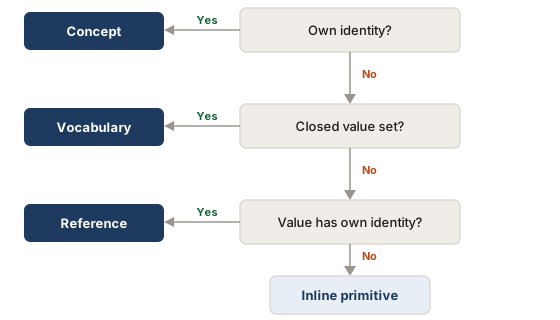
Step 1: Does it have its own identity? Does this thing exist independently, get referenced from multiple places, and have its own lifecycle? If yes, it is a concept.
Example: GroupMembership is a concept, not a property on Person or Group. It carries its own data (role, dates), has its own lifecycle, and is referenced from both sides.
Step 2: Is it an attribute of a concept? A fact about a specific concept, with no independent identity? If yes, it is a property. Multiple values (e.g., phone numbers) still make it a property with cardinality many.
Step 3: Is the value drawn from a closed set? If the property accepts one answer from a defined list with stable meanings, the value set is a vocabulary.
Step 4: Reference or inline? If the value has its own identity and properties, reference a concept (concept: Location). If it is a simple scalar, use an inline primitive.
Example: latitude is an inline decimal on Location. It has no independent identity, no sub-properties. It is a number.
| Situation | Element type |
|---|---|
| Own lifecycle, referenced from multiple concepts | Concept |
| Attribute of a concept, no independent identity | Property |
| Value from a closed set of options | Vocabulary |
| Value has its own identity and sub-properties | Property referencing a concept |
| Simple scalar | Inline primitive type |
5. Temporal context
Almost everything in public service delivery is time-bounded. A status snapshot without a validity period is incomplete. When designing a concept or property, ask: will this value change over time? If yes, model the temporal context explicitly (start/end dates, validity periods).
Date property conventions
Lifecycle concepts use domain-specific named dates that describe the domain event. Relationship and membership concepts use generic start_date / end_date.
| Concept type | Date pattern | Examples |
|---|---|---|
| Lifecycle (Enrollment) | Domain-specific named dates | enrollment_date, exit_date |
| Lifecycle (Entitlement) | Domain-specific period | coverage_period_start, coverage_period_end |
| Lifecycle (Grievance) | Domain-specific event dates | submission_date, resolution_date |
| Single event (PaymentEvent) | Single event date | payment_date |
| Relationship (GroupMembership, Relationship) | Generic dates | start_date, end_date |
Do not mix both patterns on the same concept. A lifecycle concept should not carry both enrollment_date and start_date.
6. Property independence
A property like start_date is defined once and reused across concepts. When a shared property needs concept-specific value sets (e.g., status on Enrollment vs. Grievance), it specializes via different vocabulary references rather than pretending the differences don't exist.
7. Sensitivity annotations
Some properties reveal sensitive circumstances regardless of whether they identify a specific person. program_ref reveals enrollment in a specific program (which may target HIV, disability, or poverty). grievance_type reveals that someone filed a complaint.
| Level | When to use | What it signals |
|---|---|---|
standard |
Default. No special handling beyond normal data protection. | Can be omitted (assumed if absent). |
sensitive |
Reveals circumstances (health, poverty, victimhood) in most contexts. | Requires justification to collect or disclose. |
restricted |
Should not appear in credentials at routine service points. | Requires a Data Protection Impact Assessment. |
This is a practitioner warning, not a compliance label. Whether a property constitutes personal data depends on the record it appears in, not the property itself. See Selective Disclosure for credential-level classification.