Selective Disclosure
Privacy design for Verifiable Credentials using SD-JWT.
Overview
PublicSchema credentials are designed for use with SD-JWT VC (Selective Disclosure JWT Verifiable Credentials), enabling holders to reveal only the claims needed for a specific interaction.
Data Classification Approach
PublicSchema does not assign a fixed data classification to individual properties. Whether a property is personal data depends on the record it appears in, not the property itself. For example, date_of_birth on a Person record is personal data; the same field in an aggregate statistical table is not.
Instead, disclosure behavior is defined at the credential level. Each credential type below specifies which claims are always disclosed and which are selectively disclosable.
For property-level sensitivity annotations, see Schema Design: Sensitivity annotations.
Vocabulary values in credentials
Not all vocabulary values belong in credentials.
Stable facts, not transient states. A VC should attest to facts that remain meaningful over time ("this person is eligible"), not process states that change within hours ("this application is under review").
No draft values in production credentials. A draft value's meaning may change. Issuers should only use values at candidate or normative maturity.
Identifier type alone is insufficient. identifier_type: national_id_number is meaningless without the issuing jurisdiction and identifier scheme. Vocabularies used in credentials should document what additional context is needed.
Credential Structure for SD-JWT VC
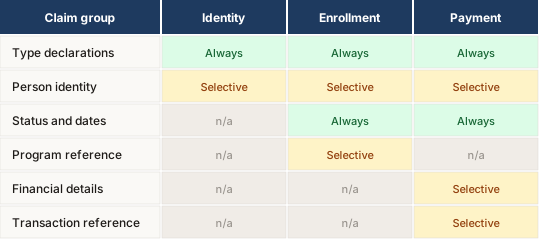
IdentityCredential
Always disclosed:
type(Person)
Selectively disclosable:
given_name,family_name,namedate_of_birthgender,sexnationality,marital_status,education_levelphone_numberidentifiers(each identifier can be disclosed independently)
Use case: Age verification without revealing full identity. A verifier needs to confirm the holder is over 18. The holder discloses only date_of_birth, keeping given_name, phone_number, and other PII hidden.
EnrollmentCredential
Always disclosed:
type(Person + Enrollment)enrollment_statusis_enrolledenrollment_date,start_date
Selectively disclosable:
program_ref- Person identity claims (given_name, family_name, date_of_birth)
beneficiaryreference
Use case: Proof of active enrollment for service access. A health clinic verifier needs to confirm the holder is enrolled in a program. The holder discloses enrollment_status (active) and is_enrolled (true), keeping program identity and personal details hidden.
PaymentCredential
Always disclosed:
type(Person + PaymentEvent)payment_statuspayment_date
Selectively disclosable:
entitlement_refenrollment_refpayment_amount,payment_currencydelivery_channelidentifiers(including any transaction_reference entries)failure_reason- Person identity claims
Use case: Proof of payment receipt. An auditor needs to verify payments were made. The holder discloses payment_amount, payment_date, and the transaction_reference entry from identifiers, but not their personal identity. For failed payments, failure_reason can be disclosed to support dispute resolution.
VoucherCredential
Always disclosed:
type(Voucher)voucher_statusserial_numberexpiry_date
Selectively disclosable:
entitlement_refissued_toredeemable_byamount,currencyvoucher_formatitems(each delivery item can be disclosed independently)issue_dateredemption_date,redeemed_by,redemption_agent
Use case: Voucher redemption at a vendor. The holder presents the voucher credential. The vendor needs to confirm the voucher is valid (status), identify it (serial number), and check it has not expired (expiry date). The holder can selectively disclose the face value or commodity basket (items) while keeping their identity hidden. Post-redemption fields (redemption_date, redeemed_by) support audit without requiring re-presentation of identity claims.
EntitlementCredential
Always disclosed:
type(Entitlement)entitlement_statuscoverage_period_start,coverage_period_end
Selectively disclosable:
enrollment_refschedule_refbenefit_modalitybenefit_descriptionamount,currencydocument_expiry_date- Person identity claims (via enrollment chain)
Use case: Proof of benefit entitlement. A beneficiary needs to demonstrate they are entitled to a benefit for a specific period (e.g., to access a complementary service). The holder discloses entitlement_status (approved) and coverage period, keeping program details and identity hidden. Note: per-cycle entitlements are short-lived, so credential rotation is frequent; document_expiry_date controls VC validity independent of the coverage period.
ProfileCredential (SocioEconomicProfile, FunctioningProfile, plus humanitarian subtypes such as AnthropometricProfile)
A Profile record can be used as a credential in two patterns, and adopters choose based on use case.
Pattern A: Profile-as-subject. The credential subject is the Profile itself. The Person (via subject reference) is one claim among the administrative context. Suitable when a holder wants to present evidence of a specific administration (a WG-SS interview with an enumerator, an anthropometric screening), with the item-level answers as disclosable claims.
Pattern B: Profile-as-evidence. The credential subject is the Person. The Profile is included as evidence backing a separately scored claim on the Person (e.g., "this person meets the WG cutoff 3 disability identifier"), produced by a ScoringEvent that references the Profile in inputs. Suitable when the verifier only needs the derived band and can treat the raw responses as restricted.
Always disclosed (Pattern A):
type(Profile subtype)instrument_used(identity and version of the instrument)observation_date
Selectively disclosable:
subject(Person identity)performed_by,respondent,respondent_relationshipadministration_mode- All item-level properties (each WG/CFM item, each anthropometric measurement, each socio-economic item disclosed independently)
- Derived fields (z-scores, status bands)
Use case: A case worker requests a WG-SS administration as part of a disability-informed service decision. With Pattern A, the holder discloses the instrument used, date, and the relevant item answers (for example, only the seeing and hearing items) while keeping the other functioning items hidden. With Pattern B, the holder presents a DisabilityIdentifierCredential whose subject is the Person and whose evidence points to a FunctioningProfile held by the issuer; the verifier sees the derived identifier, not the items.
Because Profile subtypes carry potentially sensitive data (health, nutrition, poverty), every item-level claim should default to selectively disclosable. Verifiers should request the minimum set of items needed and should not assume a positive response on any item implies a classification without the corresponding ScoringEvent.
SD-JWT VC Payload Structure
An SD-JWT VC separates always-disclosed claims from selectively disclosable ones using the _sd mechanism. Here is how an EnrollmentCredential maps:
{
  "iss": "did:web:registry.example.gov.sn",
  "sub": "did:web:registry.example.gov.sn:persons:4421",
  "iat": 1706745600,
  "nbf": 1706745600,
  "exp": 1738435200,
  "vct": "https://publicschema.org/schemas/credentials/EnrollmentCredential",
  "_sd_alg": "sha-256",
  "cnf": {
    "jwk": { "kty": "EC", "crv": "P-256", "x": "...", "y": "..." }
  },

  "credentialSubject": {
    "type": "Person",
    "_sd": [
      "...hash(given_name)...",
      "...hash(family_name)...",
      "...hash(date_of_birth)...",
      "...hash(gender)..."
    ],
    "enrollment": {
      "type": "Enrollment",
      "enrollment_status": "active",
      "is_enrolled": true,
      "enrollment_date": "2025-01-15",
      "start_date": "2025-02-01",
      "_sd": [
        "...hash(program_ref)...",
        "...hash(beneficiary)..."
      ]
    }
  }
}
Note: PublicSchema credential schemas use the SD-JWT VC format exclusively. SD-JWT VC payloads use vct (verifiable credential type) instead of W3C VCDM's @context and type arrays. The cnf claim binds the credential to the holder's key for key binding proof. The generated JSON Schemas in dist/schemas/credentials/ validate SD-JWT VC payloads, not W3C VCDM envelopes.
The _sd array contains hashes of the disclosable claims. The actual values are provided separately as disclosures that the holder can choose to include or omit when presenting the credential.
Traditional Data Handling Guidance
Data handling requirements depend on the credential or dataset context, not on individual property definitions. Implementers should assess each deployment and apply protections based on whether the data, in that context, identifies or relates to a natural person.
General guidance:
- Structural metadata (program parameters, statuses, dates) typically requires no special handling beyond normal data protection.
- Person-linked data (identity claims, person-specific records) requires standard protections: access control, encryption at rest, defined retention periods.
- Sensitive data (properties that reveal circumstances like health status, poverty, or victimhood in most contexts) requires justification to collect or disclose. See the
sensitivityannotation in Schema Design. - Restricted data (assessment scores, vulnerability indices) requires enhanced protections: audit logging, purpose limitation, Data Protection Impact Assessment.
Consent Receipt VC
A ConsentRecord with consent_record_type = receipt is a natural candidate for a Verifiable Credential, particularly for programs moving toward wallet-based data governance. This pattern is aligned with ADR-009 decision 24 and is ready for future wallet deployments; it is not a day-one expectation.
The Consent Receipt VC allows a data subject to carry proof of what was agreed, which notice was presented, and who the controllers are, without relying on the program's registry being online at verification time. It is consistent with Kantara Consent Receipt v1.1 intent and ISO/IEC TS 27560:2023 receipt semantics, and uses the SD-JWT VC format defined elsewhere in this document.
Must-disclose claims (cannot be hidden by the holder):
data_subject(the identity of the data subject, as an identifier; the full identity claims are on the IdentityCredential)controllers(the organisations responsible for the processing)purposes(the DPV purpose URIs that were agreed)legal_basis(the legal basis code, e.g.,consent,public_interest)signed_date(the date the data subject indicated agreement)status(the current status of the consent, e.g.,given,withdrawn)
Selectively disclosable claims:
evidence_ref(the holder may not wish to expose where evidence artefacts are stored)witnessed_by(the identities of witnesses; the holder may choose not to disclose)- Individual values within
personal_data_categories(each DPV URI may be disclosed independently; the holder might disclose health-data categories to a health provider without exposing financial-data categories) recipients(specific recipient organisation identities; disclosure per recipient is possible)expiry_dateandeffective_date(validity dates are disclosable independently)notice_refandnotice_version(reference to the notice; a holder might disclose these to a verifier who needs to inspect the full notice)special_category_basis(only relevant when special-category data is involved)jurisdiction
Implementation note. At v1, most programs will issue Consent Receipt VCs as records in their registry, not as wallet-held credentials. The claim structure above is designed so that when wallet infrastructure is available, the same ConsentRecord serialisation maps directly to the VC payload without restructuring. The vct value for a ConsentReceiptCredential will be https://publicschema.org/schemas/credentials/ConsentReceiptCredential once that credential type is formally published.
Implementation Guidance
Issuers should consult the credential type definitions above when constructing SD-JWT VCs. Claims listed as "always disclosed" go in the clear; "selectively disclosable" claims go in
_sd. For properties not covered by a defined credential type, the issuer determines disclosure behavior based on credential context.Holders (wallet applications) should present a disclosure selection UI distinguishing always-disclosed claims from selectively disclosable ones. Inherently sensitive claims (assessment scores, vulnerability indices) should require explicit confirmation. When in doubt, default to selectively disclosable to err on the side of privacy.
Verifiers should request only the claims they need. A request for inherently sensitive claims should include a justification (e.g., audit authority reference).
The build pipeline outputs property metadata in
vocabulary.json. Wallet and verifier implementations should use the credential type definitions in this document to configure disclosure policies.
See a problem on this page? Report it on GitHub.
Help improve this page
Highlight any text on this page to leave an annotation. Join our review group to get started.
If you have a GitHub account, click the feedback icon next to any section heading to report a specific issue.