Versioning and Maturity
Stability guarantees, maturity levels, and URI persistence.
Why stability matters
Stable URIs are essential for Verifiable Credential compatibility. A credential issued today must remain verifiable years from now. If a URI changes or disappears, every credential that references it becomes unresolvable.
Two versioning axes
"Is this element safe to use?" and "which snapshot am I building against?" are different questions. PublicSchema answers them independently.
Per-entity maturity
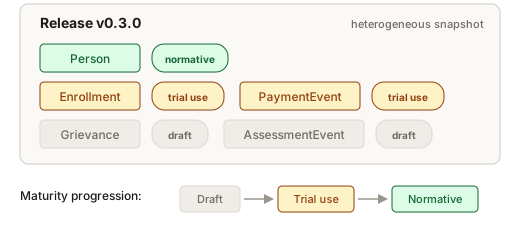
Every concept, property, and vocabulary value carries a maturity level:
| Level | Meaning | What can change |
|---|---|---|
| Draft | Proposed, open for feedback. | May be renamed, restructured, or removed. |
| Candidate | Stable enough for early adopters. | Breaking changes require advance notice. |
| Normative | Locked. Production-safe. | Changes require a new URI. |
Maturity progresses in one direction. A concept at candidate will not regress to draft. Three levels (not five, as in FHIR's FMM 0-5) map to a clear mental model: experimental, early adopter, stable.
Maturity applies to individual vocabulary values, not just vocabularies. A normative vocabulary can contain a draft value. Draft values should not appear in production credentials.
Vocabulary-level versus value-level maturity. These are two distinct things. The vocabulary-level maturity (the maturity field on the vocabulary YAML itself) governs the contract for the vocabulary as a whole: can codes be renamed, removed, or have their meaning changed? Value-level maturity governs each individual code within that vocabulary. A vocabulary marked candidate can still grow additively: new values may be added (adding is never a breaking change) even though existing values are locked at their current meaning. Breaking changes to existing values, such as renaming a code, removing a code, or changing what a code means, apply the whole vocabulary's breaking-change discipline regardless of the value's own maturity marker. Concretely: consent-status is currently draft at the vocabulary level because the curated value set is expected to grow over time (values such as suspended, pending-verification, or pending-witness may be added as field programs report their needs). Individual values within it, such as given and withdrawn, have meanings locked by the DPV alignment and will not change semantically even as the vocabulary grows.
Maturity is per-element, not per-dependency-chain. A property's or a vocabulary's maturity is decided by that element's own contract stability, not by the maturity of the concepts that reference it. A date field such as enrollment_date can be normative even when the Enrollment concept that uses it is still candidate: the property's contract is "a date in ISO 8601 format that marks when an enrollment began", which is stable regardless of how many more properties Enrollment might grow. Likewise, a controlled vocabulary such as sp/grievance-type can be normative while the Grievance concept is candidate, because the vocabulary's contract is the set of codes and their meanings, not the wider shape of the concept that uses it. What a normative property/vocabulary locks down is its own shape and semantics; what remains candidate at the concept level is the concept's overall property set and relationships. Breaking the concept's shape does not break the normative property: adding, removing, or renaming properties on Grievance does not invalidate the grievance_type URI, definition, or value set. If the property's own definition needs to change, that still triggers the property's maturity rules (ADR + new URI at normative).
Release versioning
Semver on _meta.yaml:
- Patch (0.1.1): fix definitions, add translations, fix system mappings.
- Minor (0.2.0): add concepts, properties, or vocabularies. Promote maturity levels.
- Major (1.0.0): breaking changes to candidate or normative entities.
A release is a heterogeneous snapshot: version 0.3.0 may contain normative, candidate, and draft entities. The release version says nothing about individual entity stability; the maturity field does.
How things evolve
Adding values is safe. Existing consumers that don't recognize a new code will ignore it.
Renaming or removing values is breaking. At draft: acceptable with notice. At candidate: requires deprecation period. At normative: requires a new vocabulary version.
When a new domain is added:
- Review universal vocabularies for values that would mean something different in the new domain.
- Create domain-scoped vocabularies only when needed, not preemptively.
Context versioning
The JSON-LD context is versioned: ctx/draft.jsonld during pre-release, then ctx/v0.1.jsonld, ctx/v1.jsonld, etc. Older versions remain resolvable indefinitely. Within a version, only additive changes are made. Removing or renaming a term requires a new context version.
URI persistence
Every element gets a stable URI:
- Concepts:
https://publicschema.org/Person,https://publicschema.org/sp/Enrollment - Properties:
https://publicschema.org/given_name - Vocabularies:
https://publicschema.org/vocab/gender-type
Once published at candidate or above, a URI will not be removed. Deprecated terms continue to resolve with metadata indicating the replacement.
Publishing a draft on the site does not start that persistence guarantee: draft URIs may still change with notice. Candidate publication is the persistence threshold; normative maturity additionally locks meaning as described above. Draft adopters should pin a source revision and consult the domain migration dispositions before updating. A recorded replacement explains the change; it does not by itself assert semantic equivalence.
Licensing
The reference model in schema/ is licensed under CC-BY-4.0. Build tooling and tests under Apache-2.0.
CC-BY-4.0 was chosen over CC0 (loses attribution tracking) and CC-BY-SA (share-alike clause discourages adoption by governments and corporate integrators). Embedding the JSON-LD context URL satisfies the attribution requirement.
See a problem on this page? Report it on GitHub.
Help improve this page
Highlight any text on this page to leave an annotation. Join our review group to get started.
If you have a GitHub account, click the feedback icon next to any section heading to report a specific issue.